Nigeria's largest electricity companies will shut down power supplies unless the government pays longstanding bills it owes them and improves gas supplies, a joint statement said on Wednesday.
In 2013, Nigeria -- famous for blackouts -- started selling parts of its moribund state electricity firm, in a privatization that was meant to improve power supplies and attract billions of dollars in new investments - neither of which happened.
If the companies make good their threat, most industries and residential homes will be in darkness except for those that rely on expensive diesel generators.
Six power generating companies, known as Gencos, which had bought parts of the state firm, said they would shutdown electricity generation imminently if a debt of 156 billion naira ($485 million) owed from a government agency was not paid. They also said banks were recalling loans made to them.
Nigeria has paid arrears of 186.7 billion naira. The central bank has stepped in with a $213 billion loan to keep the system afloat and allow the power firms to access credit, but more is needed as the oil price slump pressures Nigeria's currency.
The companies, which include Transcorp's power subsidiary and Forte Oil's power unit, said they struggled to repair their networks because imports of spare parts had become too expensive due to naira devaluation.
"In 2013, exchange rate was 150 naira per dollar. Today it is 310. How can we repair, equip, acquire new turbines at this rate of 310 naira per dollar and yet still operate with an old tariff?," said the companies.
"(A) shutdown is indeed imminent," they said in a statement.
The naira has lost 40 percent of its value since Nigeria ditched its 16-month-old peg of 197 naira to the dollar in June in a bid to lure back foreign investors who fled both the equities and bond markets after the plunge in crude prices.
After the privatisation, the government pledged to review tariffs as more power is generated and upgrade the transmission network to give more people access to the grid. But tariff reviews have not kept pace with rising cost, worsened now by the naira devaluation, analysts say.
In February, the Nigerian Electricity Regulatory Commission (NERC) increased tariffs by 45 percent, triggering protest from consumers, already under pressure from rising inflation, which hit a 10-year high in June. But the tariff increase was not enough to cover their cost, generating companies say.
As of July, the generating firms have received only 28.6 percent of their April invoices, they said.
Chronic power shortages are one of the biggest constraints on investment and growth in Africa's largest economy. Producing less than 4,000 megawatts, Nigeria's requires ten times the amount it currently produces to guarantee power to its 170 million people.
However, the generating firms are holding off on expansion. Generating companies have around 5,000 megawatts of spare capacity which has no access to gas, they say.
Thursday, 11 August 2016


Nigeria avoid Brazil, get Denmark in Olympic quarter-finals
The Olympic Eagles would play the Europeans rather than the hosts in Saturday’s last eight game in Sao Paulo
After Wednesday’s final group matches at the Olympic Games, Nigeria will play Denmark in the quarter finals as Brazil rallied to an emphatic win to top Group A.
Group B winners Nigeria were on collision course with the Selecao Olimpica until the hosts defeated the Europeans 4-0 to emerge Group A winners.
New Manchester City signing, Gabriel Barbosa scored twice with both Luan and Gabriel Jesus adding one each to see the Neymar-inspired side get their first win of the tournament.
Brazil finished top of Group A with five points while Denmark were second with four points despite the pummeling.
South Africa and Iraq both crashed out after their 1-1 draw in the group’s other game.
Nigeria, Africa’s sole surviving representative in Olympic Football, lost 2-0 to Colombia but had already qualified as Group B winners following their opening victories against Japan and Sweden.
Despite Japan’s 1-0 defeat of Sweden in the other Group B game, Colombia joined Nigeria in the quarter finals.
The quarter final fixtures are as follows: Portugal vs Germany, Nigeria vs Denmark, South Korea vs Honduras and Brazil vs Colombia.
All matches will be played on Saturday, August 13, 2016.
After Wednesday’s final group matches at the Olympic Games, Nigeria will play Denmark in the quarter finals as Brazil rallied to an emphatic win to top Group A.
Group B winners Nigeria were on collision course with the Selecao Olimpica until the hosts defeated the Europeans 4-0 to emerge Group A winners.
New Manchester City signing, Gabriel Barbosa scored twice with both Luan and Gabriel Jesus adding one each to see the Neymar-inspired side get their first win of the tournament.
Brazil finished top of Group A with five points while Denmark were second with four points despite the pummeling.
South Africa and Iraq both crashed out after their 1-1 draw in the group’s other game.
Nigeria, Africa’s sole surviving representative in Olympic Football, lost 2-0 to Colombia but had already qualified as Group B winners following their opening victories against Japan and Sweden.
Despite Japan’s 1-0 defeat of Sweden in the other Group B game, Colombia joined Nigeria in the quarter finals.
The quarter final fixtures are as follows: Portugal vs Germany, Nigeria vs Denmark, South Korea vs Honduras and Brazil vs Colombia.
All matches will be played on Saturday, August 13, 2016.
Syria conflict: Russia to halt to Aleppo action to allow aid in
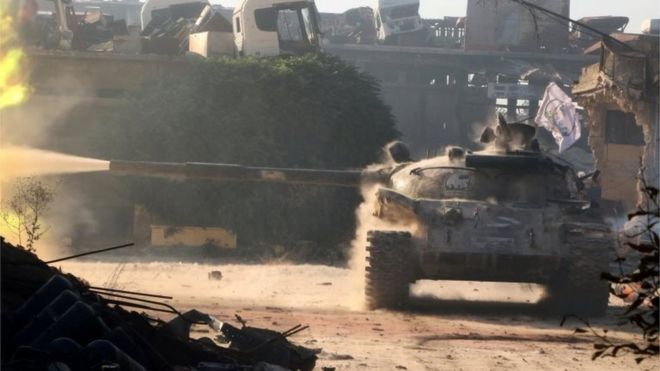
Russian forces are due to suspend military action in the northern Syrian city of Aleppo shortly to allow in desperately needed humanitarian aid.
It is not clear if Syrian rebel groups will also cease fire during the daily three-hour window.
But UN officials say that is too short to take in enough to help the large numbers of people in need.
Intense fighting has been continuing in Aleppo between rebels and Russian-backed Syrian government forces.
There are also reports of a toxic gas attack on a rebel-held area. Medical staff say four people died and many other were injured. The gas is thought to have been chlorine dropped in a barrel bomb.
Earlier the last doctors in the rebel-held east of the city appealed to US President Barack Obama to come to the aid of the 250,000 civilians there.
A letter calls on Mr Obama to impose a no-fly zone over Aleppo to stop air strikes.
All Russian military action, air and artillery strikes would be halted between 10:00 (07:00 GMT) and 13:00, a defense ministry official told a briefing in Moscow on Wednesday.
But UN Emergency Relief coordinator Stephen O'Brien that to meet the needs "you need two (road) lanes and you need to have about 48 hours to get sufficient trucks in."
"United Nations agencies and our partners remain ready to assist the civilian population across Aleppo. We have supplies ready to roll - food rations, hospital supplies, ambulances, fuel for generators, water supplies and more.
"We will continue to use all available routes and mechanisms to do this, including cross-line and cross-border operations from Turkey. We can deliver these within 24-48 hours - if we have safe access," Mr O'Brien said.
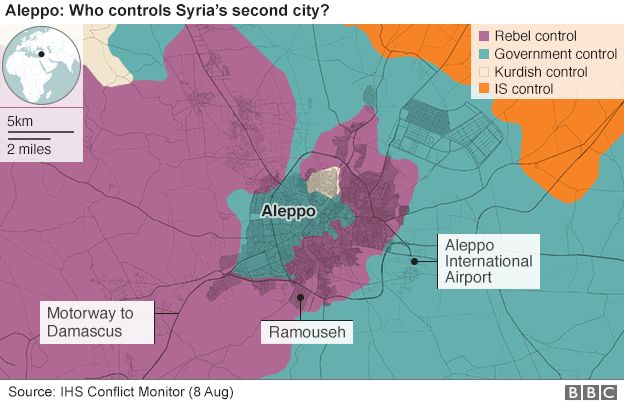
Fighting has escalated in Aleppo in recent days, with rebels severing the government's main route to the west of the city.
The offensive sought to break a siege by pro-government forces, who encircled the east in July with the support of Russian aircraft.
The remaining Aleppo doctors say in their letter that in the five years since the uprising against President Bashar al-Assad began, they have "borne witness as countless patients, friends and colleagues suffered violent, tormented deaths".
"The world has stood by and remarked how 'complicated' Syria is, while doing little to protect us. Recent offers of evacuation from the regime and Russia have sounded like thinly veiled threats to residents - flee now or face what fate?"
They say that in the past month there have been 42 attacks on medical facilities in Syria, 15 of them on hospitals where they work.
On Monday, the UN said countless civilians had been killed or injured over the past few weeks in the city, and that the targeting of hospitals and clinics had continued unabated.
Moreover, attacks on civilian infrastructure had left more than two million people without electricity or access to the public water network for several days, it added.
Product might cost N151 per litre soon
Petroleum marketers are agitating for the price of fuel to be increased to N151 per liter, according to reports.
They said the current price of N145 is not realistic because of the challenges in getting foreign currency, adding that the real cost of fuel should be N151.87k.
This is coming on the heels of reports that there are plans to increase the pump price of fuel soon.
Punch also reports that the marketers also called on the Federal Government to address the issue of the rising dollar, so they can sell fuel at the approved rate of N145.
To forestall any further drop in supply, reports say a stakeholders' meeting was held to deliberate on the issue.
Those in attendance were officials of the Nigerian National Petroleum Corporation (NNPC), Ministry of Petroleum Resources, the Petroleum Products Pricing Regulatory Agency (PPPRA), Major Oil Marketers Association of Nigeria (MOMAN), Independent Petroleum Marketers Association of Nigeria, Depot and Petroleum Products Marketers Association and Nigeria Association of Road Transport Owners.
An official who was at the meeting, said “Since the ex-depot price is around N133.5 per liter and the selling price is N145 litre, when you remove the ex-depot cost from the selling price, you’ll get about N12. Now, from this N12, consider the distribution margin and other costs from the depot; if all these costs are less than N12, then the marketers are making profits and there will be no complaint.
“But if the reverse is the case, then they have a complaint. I want you to find out what is the marketers’ margin, transporters’ margin, bridging fund, Petroleum Equalization Fund, administrative charges and more. When you add all these together, you will realize that truly, the marketers are doing all they can to hold the pump price at the N145 per liter band.”
According to Punch, a ministry of petroleum source also said“The issue of Forex has been a challenge to both the government and the oil marketers. All of a sudden, the dollar skyrocketed to about N400 and the product we are concerned with here is an international product. So, if they are bringing in the product by buying dollar at N350, then it is obvious that they are really working hard to remain in business.
“For if we are in a truly deregulated market environment, then the price of the product should have increased beyond N145 per liter; there is no doubt about that. Meanwhile, there was a highly confidential meeting between the management of the PPPRA and stakeholders in the sector on this matter.
“I may not be able to tell you the resolutions that were reached concerning the issue of pricing of petroleum products, but the body language of those who participated in the meeting suggests that the government may be considering some form of concessions to the oil marketers as it did for the Muslim pilgrims. We all know that the government cannot afford to increase petrol price again, not at this time.”
Though the Group Managing Director (GMD) of the Nigerian National Petroleum Corporation (NNPC), Maikanti Baru, said on Tuesday, August 9, 2016, that no directive has been given to increase the fuel price, Nigerians have to buckle up for any outcome in this unfolding price drama.
Thursday, 29 October 2015
Instructions
Remote Assistance Host
- Create an invitation from the host -- the computer you want to control remotely. Click “Start” and “Control Panel.” Type “Remote Settings” in the search bar and press “Enter.” Click “Allow Remote Access to Your Computer.” Ensure that there is a check in the box, and then click “Advanced.”
- Choose the length of time for the invitation to stay open, up to 30 days. Click “OK,” and then click “OK” again.
- Click “Start” and type “Remote Assistance,” and then press “Enter.”
- Click “Invite Someone You Trust to Help You.” Save the invitation as a file and attach it to an email if you use a Web-based client, or use Outlook to automatically attach it.
- Email the invitation to an account that you can access from your remote location. The attachment automates the connection process; if you don’t receive the email, you can't control the host computer.
- Change your host computer's hibernation and sleep settings, if applicable, via the Control Panel, in Hardware and Sound, under Power Options. If the host computer is hibernating or sleeping when the Remote Assistance request comes from the remote computer, you won’t be able to connect.
- Launch your email program or website on the remote computer. Open the email you sent to yourself and the attachment with the invitation. Windows then will automatically launch its Remote Desktop Connection software.
- Connect to the host computer and perform your desired tasks. Enter your administrator password to allow changes to your system and to gain access through your computer’s firewall, if needed.
- Close the connection only when you've completed all desired tasks, as you won’t be able to reconnect without a new invitation from the host computer. Reconnect using the same process if you accidentally lose the connection on your end; if the connection is lost on the host end, you can't re-establish it.
- Before you create a Remote Assistance invitation, you have the option to instead choose "Easy Connect," which allows you to bypass the email/attachment step and generate a unique password for remote access.
Remote Assistance Connection
Tips & Warnings
Should I stop eating meat? No need, experts say
The UN’s International Agency for Research on Cancer (IARC) warned Monday that processed meats like sausages and ham cause bowel cancer, and red meat “probably” does too.
Does this mean we should stop eating meat?
By the IARC’s own account, meat has “known health benefits”.
And the agency says it does not know what a safe meat quota would be — or even if there is one.
Other specialists insist the report is no reason to drop steak from the menu, though it is probably wise for big , protein and vitamin B12, they point out, as well as iron, which humans absorb more easily from meat than from plants.
“This decision doesn’t mean you need to stop eating any red and processed meat,” said Tim Key, an epidemiologist at Cancer Research UK.
“But if you eat lots of it, you may want to think about cutting down. You could try having fish for your dinner rather than sausages, or choosing to have a bean salad for lunch over a BLT (bacon, lettuce and tomato sandwich).”
Nutritionist Elizabeth Lund from Norfolk in England said obesity and lack of exercise were a far bigger cancer risks.
“Overall, I feel that eating meat once a day combined with plenty of fruit, vegetable and cereal fibre plus exercise and weight control, will allow for a low risk of CRC,” she said, referring to colo-rectal cancer.
“It should also be noted that some studies have shown that if meat is consumed with vegetables or a high-fibre diet, the risk of CRC is reduced.”
Ian Johnson of the UK-based Institute of Food Research, said meat consumption was “probably one of many” factors contributing to relatively high rates of bowel cancer in the United States, Western Europe and Australia — parts of the developed world where more meat has traditionally been eaten.
However, “there is little or no evidence that vegetarians in the UK have lower risk of bowel cancer than meat-eaters,” he said.
The specialists point out that the cancer risk posed by a meaty diet was statistically much lower than other factors like tobacco smoking and air pollution.
The IARC report “does not mean… that eating bacon is as bad as smoking,” said University of Reading nutrition expert Gunter Kuhnle.
“Processed meat can be part of a healthy lifestyle — smoking can’t”.
According to the World Health Organization, bowel cancer is the third most common type, with some 900,000 new cases every year, and 500,000 deaths.
Generally, dietary advice is to limit red-meat intake to once or twice a week, said nutrition professor Tom Sanders of King’s College London — the equivalent of about two steaks or three hamburgers.
“The problem with this issue is that food is not like tobacco — we have to eat something.”
Glo named among Africa’s top 2 most admired brands
Globacom has been named one of Africa’s top two most admired brands for the second year running, in the annual Brand Africa 100 rankings announced in Johannesburg, South Africa recently. Globacom is the youngest brand in the Top 10 list, as other companies in the Top 10 including Dangote Group (Nigeria), MTN (South Africa), Tusker (Kenya), Mukwano (Uganda), Simu TV (Tanzania), Zenith Bank (Nigeria), Peak Milk (Nigeria), Sasco (South Africa), and Star Beer (Nigeria), were all established before the arrival of Glo, August 29, 2003.
The Award made a good outing for Nigerian companies as 11 of them made the list. South African and Kenyan brands were joint second with four places each on the list. The rankings also showed that indigenous African brands are on the rise as they constitute nearly 25% of the the Brand Africa 100.
The Founder and Chairman of Brand Africa and Chairman of Brand Finance Africa, Thebe Ikalafeng, said the rankings were increasingly significant. “They are an important metrics of the progress Africa is making in creating brands and services that respond to African conditions, needs and ambitions.”
He added that “the time has never been more opportune or urgent for Africa to develop ‘Made in Africa’ brands. The success of businesses behind these brands will enable Africa to drive its own agenda because they create jobs, contribute tax revenue necessary to fund public goods and help shape the image of Africa as an entrepreneurial and competitive continent.”
It is believed that Globacom’s commitment to innovation and affordable services since 2003 when it started business has set it apart from competition in its various markets. One of its major accomplishments is its international submarine cable, Glo 1, which has provided the much needed Internet bandwidth in West African.
Globacom recently launched what is regarded as the most innovative offering since it pioneered per second billing in 2003. Called Free Tomorrow, the promo gives back to the subscriber the next day the total value of credit spent on calls, texts and data the previous day. The company has over 35 million subscribers across the three markets where it operates.
Subscribe to:
Posts (Atom)